
Isaiah 41:10 Meaning: What 'Fear Not' Was Answering
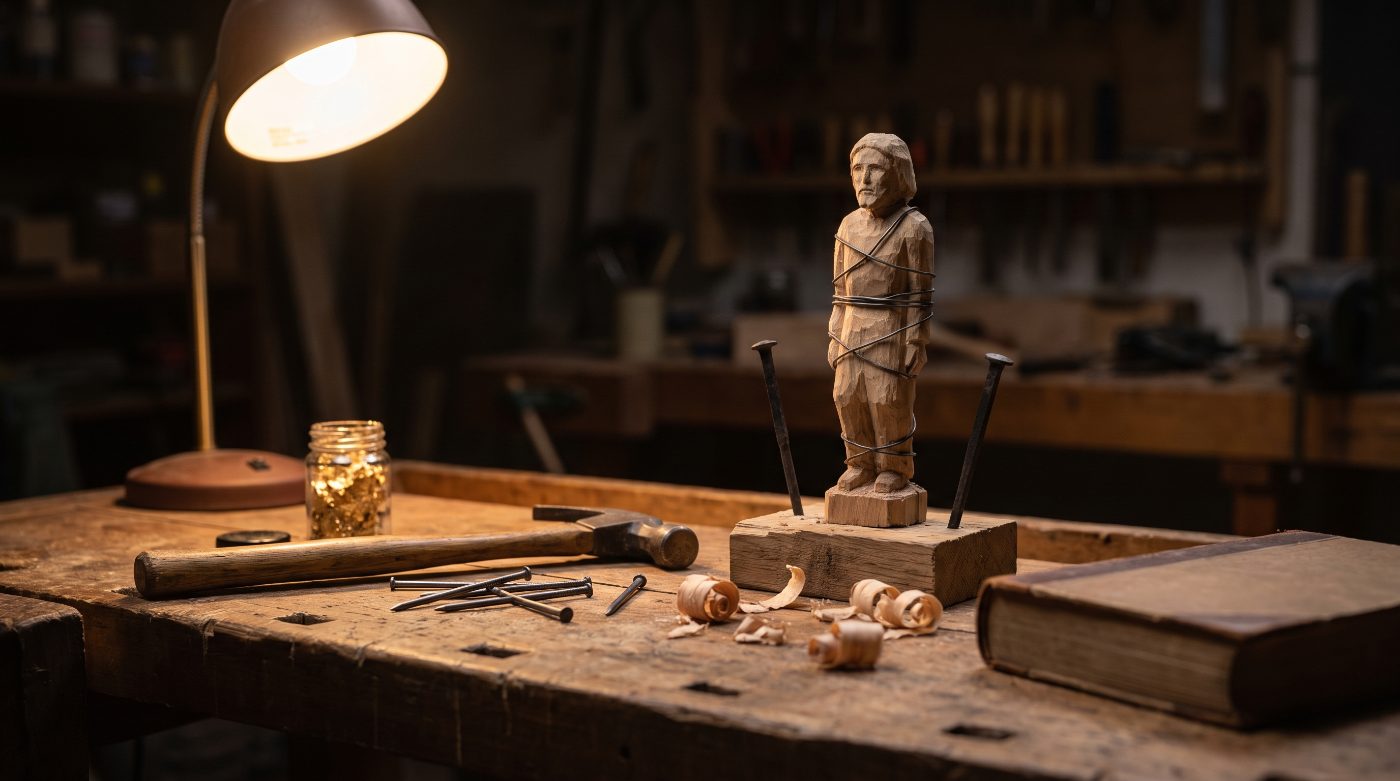
It was the most engaged-with verse in the world again in 2025, for the fourth time in six years. Three verses earlier, frightened people are nailing a statue to the floor so it won't tip over.
The short answer
Isaiah 41:10 is God speaking to Israel in exile, during an international panic over an approaching conqueror. Every promise in it is something God does: I am with thee, I am thy God, I will strengthen thee, I will help thee, I will uphold thee. None of it is a promise that the situation changes. It answers the question of who is holding you, not the question of what happens next.
Who it was said to
The audience is named in the verse just before it. "But thou, Israel, art my servant, Jacob whom I have chosen, the seed of Abraham my friend" (Isaiah 41:8). The people being addressed are in exile, far from home, under someone else's government.
They had also been talking. A chapter earlier, God quotes them back to themselves:
"Why sayest thou, O Jacob, and speakest, O Israel, My way is hid from the LORD, and my judgment is passed over from my God?" (Isaiah 40:27)
That is the complaint sitting underneath the whole passage. Not "I am afraid of what happens next," but "nobody is watching this." So "fear thou not" is not an opening pep talk. It is an answer to people who had already said out loud that they thought God had stopped paying attention.
What happens three verses earlier
Isaiah 41 opens like a courtroom. "Keep silence before me, O islands," and then a summons to come and argue it out (Isaiah 41:1). A conqueror is rising in the east and rolling over kings (Isaiah 41:2). Word spreads:
"The isles saw it, and feared; the ends of the earth were afraid, drew near, and came." (Isaiah 41:5)
Everyone is frightened at once. And then the passage does something unusual. It shows you what frightened people do with their hands.
"They helped every one his neighbour; and every one said to his brother, Be of good courage." (Isaiah 41:6)
That reads like solidarity right up until you find out what they were encouraging each other to finish.
"So the carpenter encouraged the goldsmith, and he that smootheth with the hammer him that smote the anvil, saying, It is ready for the sodering: and he fastened it with nails, that it should not be moved." (Isaiah 41:7)
It is a workshop. Carpenter, goldsmith, the man with the hammer, the man at the anvil, all of them working fast and telling each other to keep their nerve, because a god is being built and the news is bad. The last clause is the one to sit with. When the statue was finished, someone nailed it down so it would not fall over.
The "but" in verse 8
The hammering stops, and the passage turns without a pause:
"But thou, Israel, art my servant, Jacob whom I have chosen, the seed of Abraham my friend." (Isaiah 41:8)
Two verses later comes the line everybody knows:
"Fear thou not; for I am with thee: be not dismayed; for I am thy God: I will strengthen thee; yea, I will help thee; yea, I will uphold thee with the right hand of my righteousness." (Isaiah 41:10)
The two scenes are set next to each other and left there. One set of people spent the crisis holding up their god. The other is told, in the same breath as the word "uphold," that the holding runs the other direction.
What the verse actually promises
Read slowly, verse 10 is five short clauses, and every one of them is about God rather than about the situation:
- I am with thee. Presence.
- I am thy God. Who is speaking.
- I will strengthen thee. Capacity.
- I will help thee. Action.
- I will uphold thee. Weight taken.
Nothing in that list is a promise that the exile ends this year, that the conqueror turns around, or that anyone gets their house back. It is not an outcome. It is a description of who is in the room.
Three verses on, the holding gets specific:
"For I the LORD thy God will hold thy right hand, saying unto thee, Fear not; I will help thee." (Isaiah 41:13)
Not a hand on the shoulder from across the room. A hand held.
The parts that get cropped
Two things sit close to verse 10 and almost never travel with it.
The first is verses 11 and 12, which promise that the people warring against Israel will come to nothing. That is a promise made to a nation with real enemies and real borders, and it is a large part of why the passage was a comfort. It does not print well on a mug.
The second is verse 14, four words into which the passage calls its own audience something strange:
"Fear not, thou worm Jacob, and ye men of Israel; I will help thee, saith the LORD, and thy redeemer, the Holy One of Israel." (Isaiah 41:14)
The comfort is not built on the audience being strong, or brave, or worth rescuing. It is built on who is talking. That is an easier promise to hold on a bad day than one that depends on you being impressive.
Does it apply to you?
The address is specific, and the text is not shy about it: Israel, named, chosen, in exile. How directly a promise made to that people carries across to an individual reader today is a question Christians answer in different ways, and it is worth knowing that rather than being handed one answer as though it were settled.
What can be said plainly is that the same language keeps being reused. Two chapters later: "Fear not: for I have redeemed thee, I have called thee by thy name; thou art mine. When thou passest through the waters, I will be with thee" (Isaiah 43:1-2). Much later, a letter to a scattered church repeats the older promise word for word: "I will never leave thee, nor forsake thee" (Hebrews 13:5). The presence, in each case, is the point being made.
How it actually gets used
A few things follow from reading it where it sits.
- It is for the middle of something. It was spoken while the exile was still going on, not afterward, and not as a summary of how it all turned out.
- It answers the wrong question on purpose. The complaint was "my way is hid from the LORD." The reply is not an explanation. It is a hand.
- It asks nothing of the reader first. There is no condition attached, no instruction to feel brave or pray harder before the promise starts working.
- It is a verse about fear, not about anxiety management. If your mind is circling at 2am rather than facing a specific threat, the passage in Philippians 4:6-7 is the one written for that, and it also came out of a bad situation rather than a calm one.
Isaiah 41:10 is one of the ten verses in the app's Overwhelmed set, and it turns up again in the verses for when you feel lonely, which is roughly what the people in Isaiah 40:27 were describing.
The workshop scene is only three verses long. Reading Isaiah 41 from the top takes about two minutes, and the verse lands differently once you have heard the hammering.
Common questions
What does Isaiah 41:10 mean?
It is God reassuring Israel during the exile, while an approaching conqueror has the whole region frightened. The verse makes five promises and every one of them is about God rather than about circumstances: presence, identity, strength, help, and being held up. It doesn't promise that the hard situation ends, only that the person in it is not being held alone.
Who was Isaiah 41:10 written to?
The verse before it names them: "But thou, Israel, art my servant, Jacob whom I have chosen" (Isaiah 41:8). They were in exile, and a chapter earlier they had been saying "My way is hid from the LORD" (Isaiah 40:27), meaning they believed God had stopped paying attention.
What does "uphold thee with the right hand of my righteousness" mean?
It is a promise of being held up rather than propped up. The contrast is three verses earlier, where frightened craftsmen finish a statue and fasten it down with nails "that it should not be moved" (Isaiah 41:7). One god has to be steadied by its makers. Verse 13 makes the other kind of holding concrete: "I the LORD thy God will hold thy right hand."
Why is Isaiah 41:10 so popular?
It was the most engaged-with verse on YouVersion in 2025, the fourth time in six years it has taken the top spot. The app's founder attributed it to the assurance of not being alone. It is worth adding that the verse promises presence rather than a particular outcome, which is a promise that still holds on the days when nothing improves.
Sources
- King James Version (KJV) | Bible Hub — Public-domain translation used for all quoted passages
- Most popular Bible app verses for 2025 | Baptist Press — Source for Isaiah 41:10 topping YouVersion in 2025 for the fourth time in six years
Keep reading
-
Psalm 91 Meaning: The Promise the Devil Quoted
It promises that no plague will come near your house. It is also the one passage the devil quotes back to Jesus in the wilderness, and both…
-
Verses for When You Feel Anxious
Your mind won't sit still. Here are eight verses for that, and what Scripture actually tells you to do with the thoughts, not just how to feel…
-
Verses for When You Feel Overwhelmed
There's too much on you right now. Here are nine verses for exactly that, and a way to get one matched to how you're actually feeling in the…
-
What Does the Bible Say About a Relationship With God?
He wasn't remote before anything went wrong, and he didn't become distant to teach anyone a lesson. He walked, in the same garden, in the cool…